
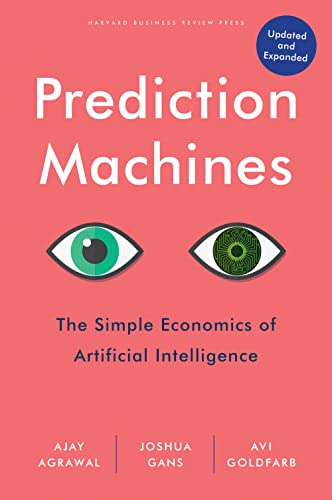
Prediction machines : The simple economics of artificial intelligence / by Ajay Agrawal, Joshua Gans and Avi Goldfarb
Material type: TextLanguage: English Publication details: Boston: Harvard Business Review Press , 2022.Description: 280 p. Hard BackISBN:
 - 9781647824679
- 658.056 3 AJA-P
 Books
Books
| Cover image | Item type | Current library | Home library | Collection | Shelving location | Call number | Materials specified | Vol info | URL | Copy number | Status | Notes | Date due | Barcode | Item holds | Item hold queue priority | Course reserves | |
|---|---|---|---|---|---|---|---|---|---|---|---|---|---|---|---|---|---|---|
|
Books
|
ST. THOMAS COLLEGE LIBRARY, PALAI | Economics | Economics | 658.056 3 AJA-P (Browse shelf(Opens below)) | Available | 92918 |
Cheap changes everything -- The magic of prediction -- Why it's called intelligence -- Data is the new oil -- The new division of labor -- Unpacking decisions -- The value of judgment -- Taming complexity -- What machines can learn -- Fully automated decision-making -- Deconstructing workflows -- Decomposing decisions -- Job redesign -- AI in the C-suite -- When AI transforms your business -- Managing AI risk -- Beyond business.
The idea of artificial intelligence--job-killing robots, self-driving cars, and self-managing organizations--captures the imagination, evoking a combination of wonder and dread for those of us who will have to deal with the consequences. But what if it's not quite so complicated? The real job of artificial intelligence, argue these three eminent economists, is to lower the cost of prediction. And once you start talking about costs, you can use some well-established economics to cut through the hype. The constant challenge for all managers is to make decisions under uncertainty. And AI contributes by making knowing what's coming in the future cheaper and more certain. But decision making has another component: judgment, which is firmly in the realm of humans, not machines. Making prediction cheaper means that we can make more predictions more accurately and assess them with our better (human) judgment. Once managers can separate tasks into components of prediction and judgment, we can begin to understand how to optimize the interface between humans and machines. More than just an account of AI's powerful capabilities, Prediction Machines shows managers how they can most effectively leverage AI, disrupting business as usual only where required, and provides businesses with a toolkit to navigate the coming wave of challenges and opportunities.--
There are no comments on this title.