
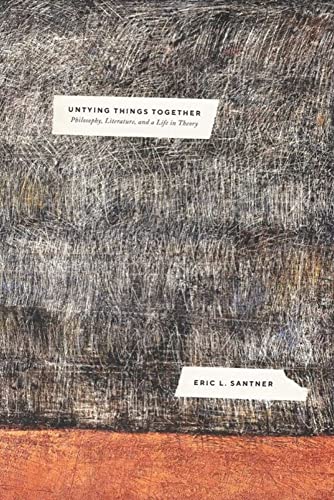
Untying things together : Philosophy, literature, and a life in theory / By Eric L. Santner
Material type: TextLanguage: English Publication details: Chicago : The University of Chicago Press , 2022.Description: xv, 250 p. Paper BackISBN:
 - 9780226816463
- 801.92 ERI-U
 Books
Books
| Cover image | Item type | Current library | Home library | Collection | Shelving location | Call number | Materials specified | Vol info | URL | Copy number | Status | Notes | Date due | Barcode | Item holds | Item hold queue priority | Course reserves | |
|---|---|---|---|---|---|---|---|---|---|---|---|---|---|---|---|---|---|---|
|
Books
|
ST. THOMAS COLLEGE LIBRARY, PALAI | English | English - Reference | 801.92 ERI-U (Browse shelf(Opens below)) | Reference Book | 93235 |
Browsing ST. THOMAS COLLEGE LIBRARY, PALAI shelves,Shelving location: English - Reference,Collection: English Close shelf browser (Hides shelf browser)
| No cover image available |

|

|

|

|

|
|
||
| 801 IAN-C The Cambridge guide to literature in English / | 801 JUL-L Literary theory : An anthology / | 801 RIC-O The oxford handbook of philosophy and literature / | 801.92 ERI-U Untying things together : Philosophy, literature, and a life in theory / | 801.950 3 IAN-D Dictionary of critical theory / | 801.950 9 HAB-A A history of literary criticism : From plato to the present / | 801.950 9 HAB-A A history of literary criticism : From plato to the present / |
"In 1905, Freud published his Three Essays on the Theory of Sexuality, the book that established the core psychoanalytic thesis that sexuality is central to formations of the unconscious. Inverting Freud's title, Eric Santner here takes up the sexuality of theory-or, more exactly, its sex-appeal, the modes of enjoyment to be found in the kinds of critical thinking that, since the 1960s, have laid claim to that ancient word, "theory." Untying Things Together is both an intellectual history of major theoretical paradigms and a call for their reexamination and renewal in light of the "postcritical turn" away from them. Santner organizes this intellectual history autobiographically as the story of his own encounters and involvements with key theorists and theoretical projects. He thereby shows that to reduce these theoretical projects to so many exercises in a "hermeneutics of suspicion" (a move associated with certain "post-critique" authors) is to miss what is most vital, most alive, indeed life-changing about them. It is to miss the "gay science" they elaborate. Santner's explorations yield new ways of accounting for the "sublime object" of theory, the libidinal charge it carries for those susceptible to its charms"--
There are no comments on this title.